Every few days during Senate recesses—including the current mid-August to mid-September break—a single Republican senator often boards a plane, flies back to Washington, walks onto an almost empty Senate floor, bangs a gavel for a few seconds, and flies home again.
The lights stay on.
The chamber is technically “in session.”
And across the internet, Trump’s base is boiling over.
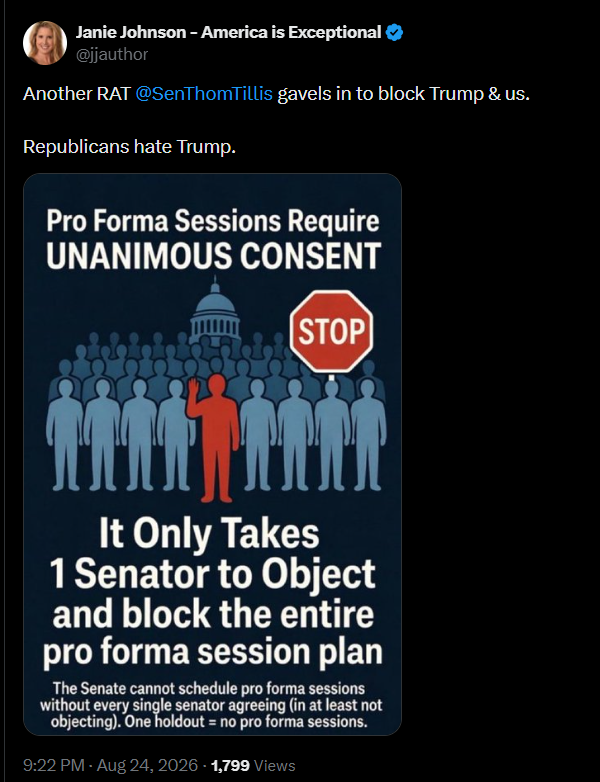
MAGA voters watch the same ugly loop: senators leave town for another long recess while the Save America Act sits untouched, then return just long enough to bang a gavel and “block” President Trump from making recess appointments.
Comment sections explode with accusations of betrayal.


“We are voting all the RATS out!” has become a rallying cry.

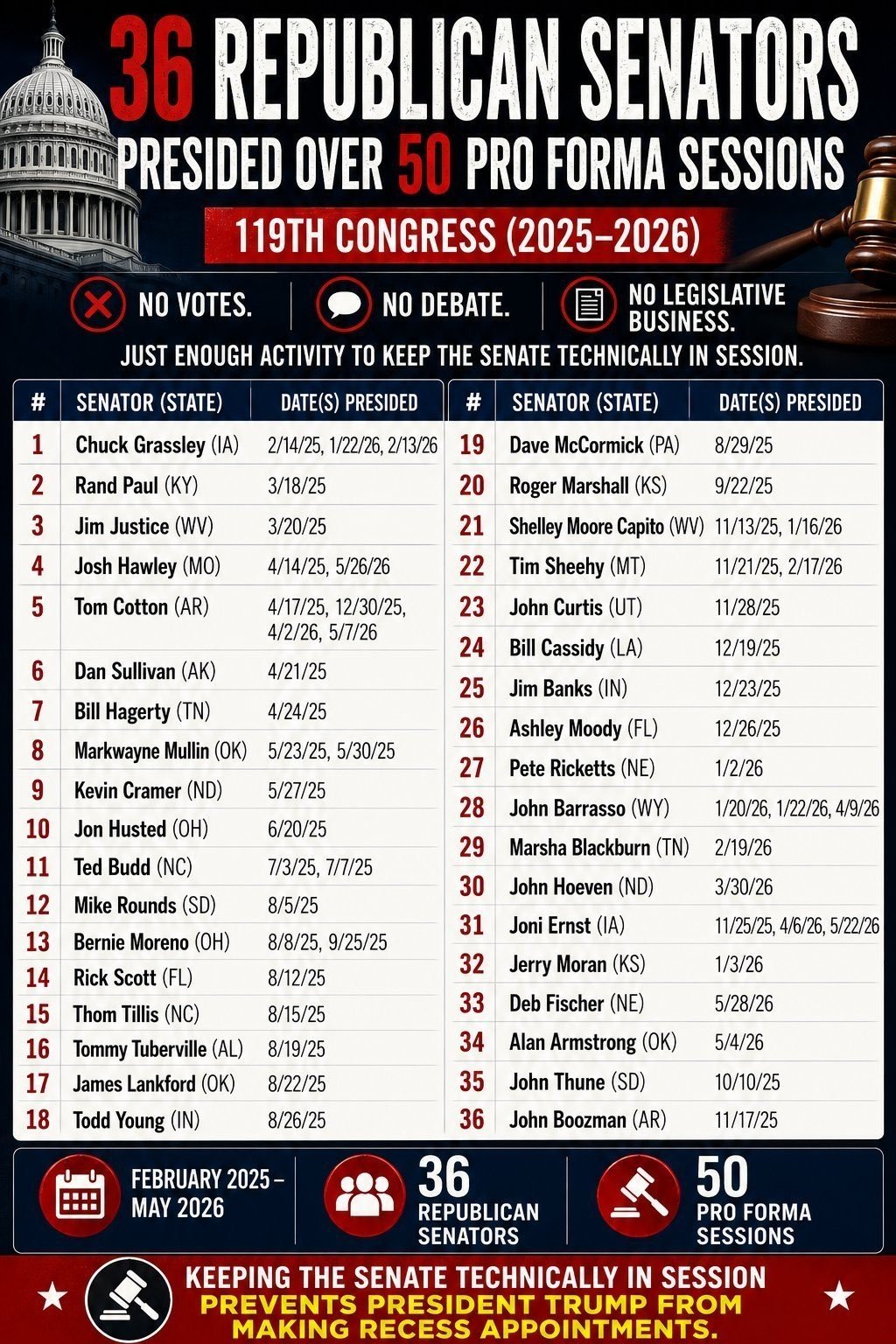
Senators who once drew standing ovations are now branded as sellouts for the thirty-second performance.
The image of senators flying in just to gavel an empty room while key legislation sits idle is genuinely damaging.


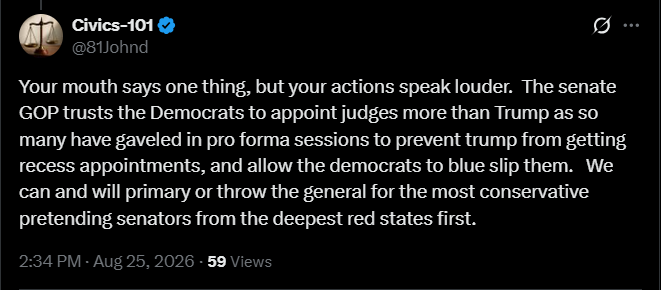

The frustration is understandable. The optics are terrible.
But here’s the part that keeps getting left out of the conversation.
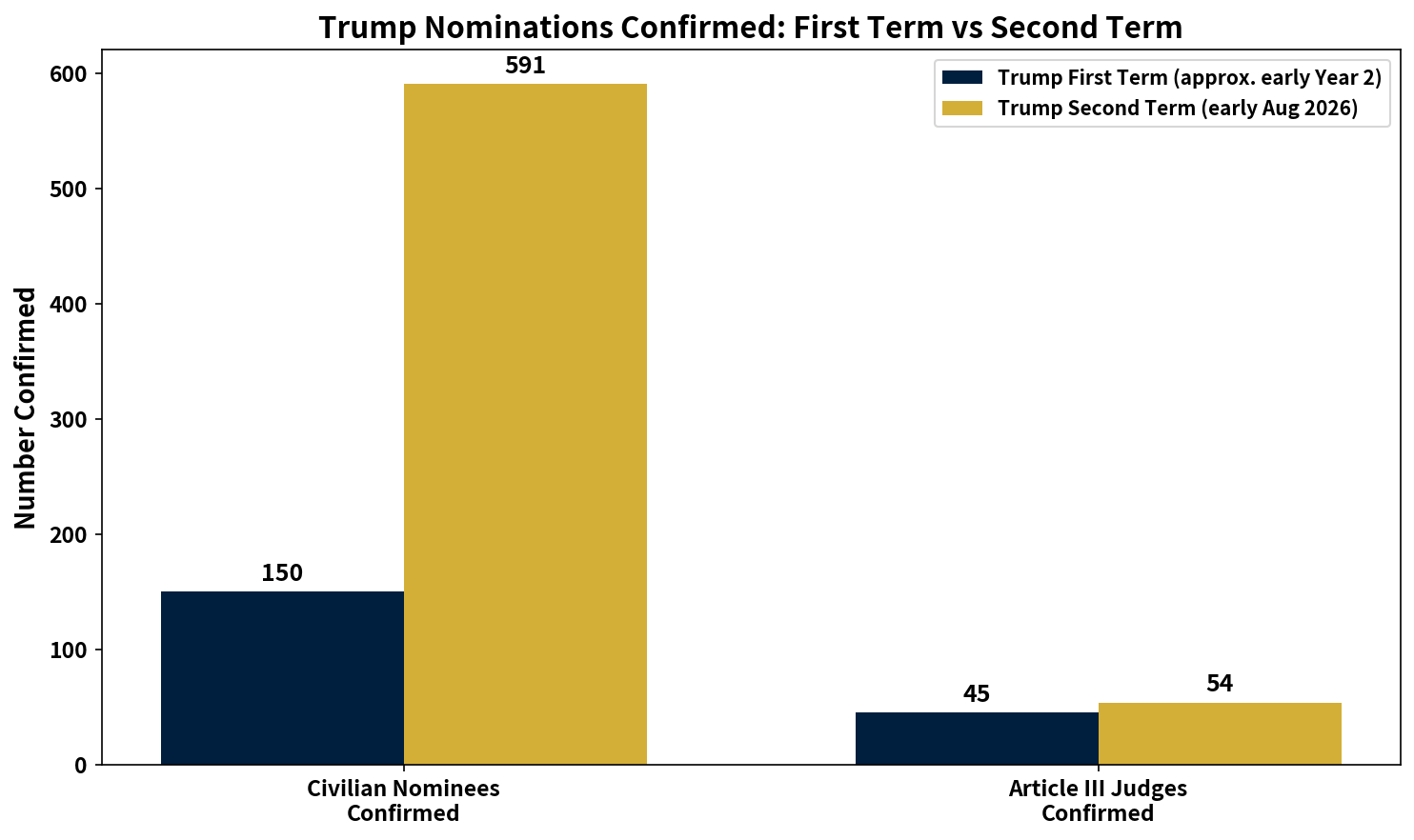
By early August 2026, Senate Republicans had confirmed 591 of President Trump’s civilian nominations in his second term. Of the civilian nominees who had actually reached the Senate floor and were ready for a vote, roughly 95 percent were already confirmed. Only about 10 remained on the calendar.
At the exact same point in Trump’s first term, 155 nominees sat stranded.
As of late August, the civilian backlog remains at roughly 10, while only 4 Article III judicial nominees are awaiting confirmation. There are currently 26 total judicial vacancies, most still without a nominee.
The confirmation record is historic.
Yet the pro forma sessions continue for one practical reason: to keep every recess shorter than 10 days so President Trump cannot make recess appointments. That is the part that still stings.
The Senate has proven it can move nominees far faster than it did in 2017. Keeping the recess-appointment door locked anyway is a deliberate choice — one that rests with leadership.
WHAT THE SENATORS TOLD THE GATEWAY PUNDIT
In the frantic hours before the August recess, as senators shuffled between votes and raced for the exits, The Gateway Pundit pressed Republican lawmakers on the practice now driving their own voters into open revolt.
Sen. Tommy Tuberville, R-Ala., went first.
Trending: Ilhan Omar’s Plea of Ignorance Regarding Marriage to Brother IMPLODES as Her Alleged Sister’s Damning Marriage Certificate Emerges
“I don’t know enough about it– about recess appointments,” Tuberville told TGP in an exclusive interview. “They said every president’s had them in the past but President Trump has not had any. You’ll have to ask leadership about why they haven’t given him the opportunity for recess appointments. But we do the pro forma. And we’ve all done that.
“We have to come here when the floor has been— nobody else is here. But we have to open the floor.”
Asked whether senators must perform the duty, Tuberville replied, “Well, you know, they put you down on a list. It’s all by volunteer basis. But, it’d be a good question to ask leadership… why they don’t allow [Trump] recess appointments.”
Sen. Josh Hawley, R-Mo., has been publicly branded “disgusting” and relentlessly dragged across comment sections for participating in the very pro forma sessions now fueling the revolt.
Confronted with the MAGA base’s fury over the gavel-ins, he made one thing crystal clear: he can’t stand them either.
“I’m not a huge fan of that practice — I have to be honest with you,” Hawley told The Gateway Pundit in an exclusive interview. “Now the good thing is… I think there will be, after we are done here tomorrow or next week, there will be no open nominations. Because we changed the rules.
“We changed the rules to be able to confirm all of the president’s nominees, which is something we ought to do with the filibuster…the Democrats were blocking all of his nominations, so we changed it so we can pass all of them. We ought to do that with the filibuster, because [Democrats are] abusing it in the same way.”
Hawley’s prediction of zero remaining nominations was close but not exact. The broader point holds: the backlog has been dramatically reduced.
Sen. Mike Rounds, R-S.D., delivered the institutional defense.
“The United States Senate is responsible for advise and consent,” Rounds told TGP in an exclusive interview.
“And regardless of Republican or Democrat, we want to have a say on those individuals,” Rounds continued. “If you are going to do recess appointments, that means the Senate walks away from its responsibilities, constitutional responsibility, to participate in that process…We are going to continue to keep that role in play by saying that we are not allowing recess appointments, whether you are a Republican or a Democrat.”
Sen. Eric Schmitt, R-Mo., drove home the results of the September 2025 rules change that first allowed en bloc confirmation of lower-level civilian nominees.
“When the Democrats were blocking the appointments… we actually changed the rules. So, we can do en bloc appointments now,” Schmitt told TGP in an exclusive interview. “It used to be, you had to do one by one. Democrats were dragging that out, and you had a record low number of appointments. Now because we changed the rules to do the en bloc appointments, we are actually ahead of pace than President Trump’s first term… We are getting those nominations through…We were… anticipating the Democrats’ obstructionism. We… accounted for that…that’s a good development.”
“I get it. As one of President Trump’s closest allies, the last thing we want to do is hold up his appointments. So, we are moving forward,” Schmitt added.
HOW RECESS APPOINTMENTS DIED

For decades, presidents of both parties routinely used recess appointments. That tool has effectively disappeared.
Reagan made 240. George W. Bush made 171. Obama made 32. Both Trump (first term) and Biden recorded zero.
The decline accelerated after Democrats began using pro forma sessions against George W. Bush in 2007 and was locked in by the Supreme Court’s 2014 NLRB v. Noel Canning decision, which held that recesses shorter than 10 days are generally too brief for the president to make recess appointments.
TRUMP’S SECOND TERM VS. FIRST TERM: THE CONFIRMATION NUMBERS
The current pace for civilian confirmation is dramatically faster than the first term at the same point. Judicial confirmations are also ahead of the early first-term rate.
The sessions still look bad.
The confirmation numbers do not.
Voters are right to hate the spectacle — and they deserve the full picture.